
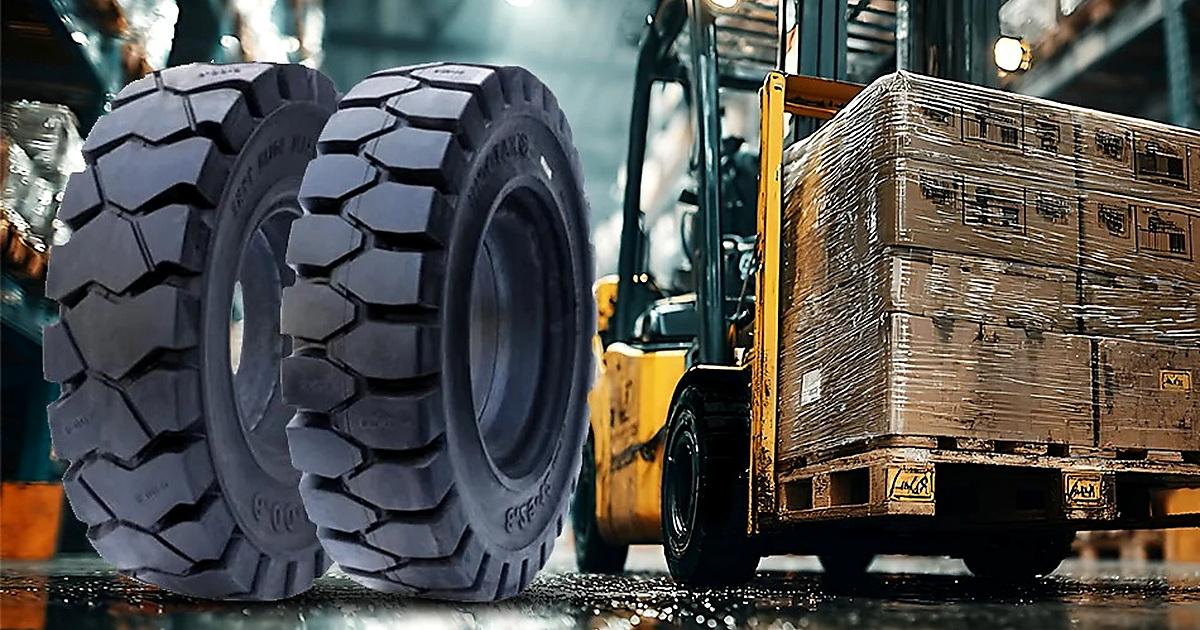
Quick answer: the best solid tyre for cold storage is a cold-resistant natural-rubber-rich solid tyre for counterbalance trucks moving between freezer and dock, and press-on (band) tyres or PU wheels for electric reach trucks that stay indoors. Standard hard compounds work, but they harden further below freezing — which means faster tread chunking, higher rolling resistance and more strain on your battery fleet. If your trucks cross the dock door more than a few times a day, specify a cold-temperature compound before you order.
Why Cold Storage Is Hard on Forklift Tyres
Cold storage combines four conditions that shorten tyre life at the same time. A tyre that performs well in an ambient warehouse can lose a significant share of its service life in a freezer environment — which is why compound selection, not just size, is the first specification decision for cold storage buyers.
- Sub-zero temperatures (-18°C to -25°C typical): the rubber compound stiffens, grip drops and low-speed flex-cracking risk rises
- Thermal cycling (freezer to ambient dock and back): repeated expansion and contraction turns small cracks into tread chunks
- Wet or icy floors at transitions: reduced traction, especially on worn tread patterns
- 24/7 multi-shift operation: tyres run warm from heat build-up and never fully recover between shifts
Compound Choices Compared
Match the compound to how much time the truck actually spends below 0°C:
- Standard industrial solid (harder compound) — ambient warehouses with occasional freezer entry; acceptable if dock crossings are rare
- Cold-resistant solid (natural-rubber-rich blend) — counterbalance trucks regularly crossing dock doors; stays flexible at low temperature and is the default choice for freezer fleets
- Non-marking grey compound — food and pharma cold chains where floor marking matters; slightly higher wear rate than black compound
- Press-on / band tyres — electric reach trucks and sit-down riders inside the freezer; see the press-on tyre guide for how the three-number size format works
- Polyurethane (PU) wheels — indoor electric stackers and low-speed pallet trucks; high resilience and floor protection, see the PU wheel range
JABIL Technical Note
Rule of thumb: the more time the truck spends below 0°C, the further you should move away from hard standard compounds toward flexible, natural-rubber-rich blends. The size is the same; the compound is the difference.
How to Specify: 4 Questions Before You Order
Answer these four questions before requesting a quotation — they cover the most common ordering mistakes in freezer fleets:
- How many dock crossings per shift? Frequent transitions justify a cold-resistant compound with a deeper tread.
- What is the actual lowest temperature the tyre reaches? Give the supplier the freezer set point, not the average warehouse temperature.
- Do floors need to stay mark-free? Food and pharma facilities usually require non-marking grey compounds — confirm against your cleaning and audit requirements.
- Is the truck counterbalance or electric reach? Counterbalance trucks typically use press-fit solid tyres on split rims; electric trucks often take press-on band tyres or PU wheels. Mixing these up is the most common ordering mistake.
Common Sizes in Cold Storage Fleets
Cold storage fleets are dominated by electric equipment, so these sizes come up most often. Full load data for each size is published on the individual size pages:
- 4.00-8 — pedestrian and small electric forklifts
- 18×7-8 — compact counterbalance and reach trucks
- 23×9-10 — 2.0–3.0 t electric counterbalance trucks
- 15×5×11 1/4 – 18×7×12 1/8 — reach truck press-on tyres; browse the press-on tyre range
- 85×100 mm and similar — PU drive and load wheels for stackers and pallet trucks
Maintenance Tips for Freezer Fleets
Four habits keep a freezer fleet moving and avoid unplanned downtime:
- Check tread more often: chunking from thermal cycling starts small — catching it early lets you rotate or replace before a shutdown
- Keep loads within spec: cold compounds give up load margin faster than ambient compounds
- Monitor battery drain: rising energy use per shift is often a rolling-resistance symptom of hardened tyres, not a battery fault
- Replace in axle pairs: mixed wear levels on a drive axle change traction behaviour on wet transition ramps
Get the Right Compound for Your Fleet
JABIL manufactures forklift solid tyres, press-on tyres and PU wheels with cold-storage-appropriate compound options, and advises on size and compound selection for freezer fleets.
Send your equipment list and freezer temperature through the quote page or contact our technical team — we will confirm the right specification within one business day.
Have questions about your specific application?
Frequently Asked Questions
Why do cold stores use solid tyres?
Rubber compounds stiffen as temperature falls, so pneumatic tyres lose flexibility and become puncture-prone in freezer work. Solid tyres hold their shape, carry the load and remove the risk of a flat inside a freezer aisle where a repair stops the whole operation.
What compound should be used in a freezer?
A cold-store compound formulated to stay flexible at low temperature. Standard compounds can harden and crack in continuous sub-zero work, so the operating temperature range must be specified on the enquiry rather than assumed.
Do solid tyres get brittle in cold storage?
Not when the compound is chosen for the application. The failure mode in cold stores is using a general-purpose compound below its intended range, then seeing chunking and cracking. Specify the temperature and duty cycle and let the compound be matched to it.
Is non-marking needed in freezer areas?
It depends on the floor finish and hygiene rules. Many food plants run black compound in the freezer and non-marking in the packing hall. If the whole site is finished to one standard, one compound may cover everything.
What else changes for freezer forklift tyres?
Load capacity derates with temperature on some compounds, and condensation on the tyre and floor affects grip. Both are reasons to send the actual operating conditions rather than ordering from a size alone.