
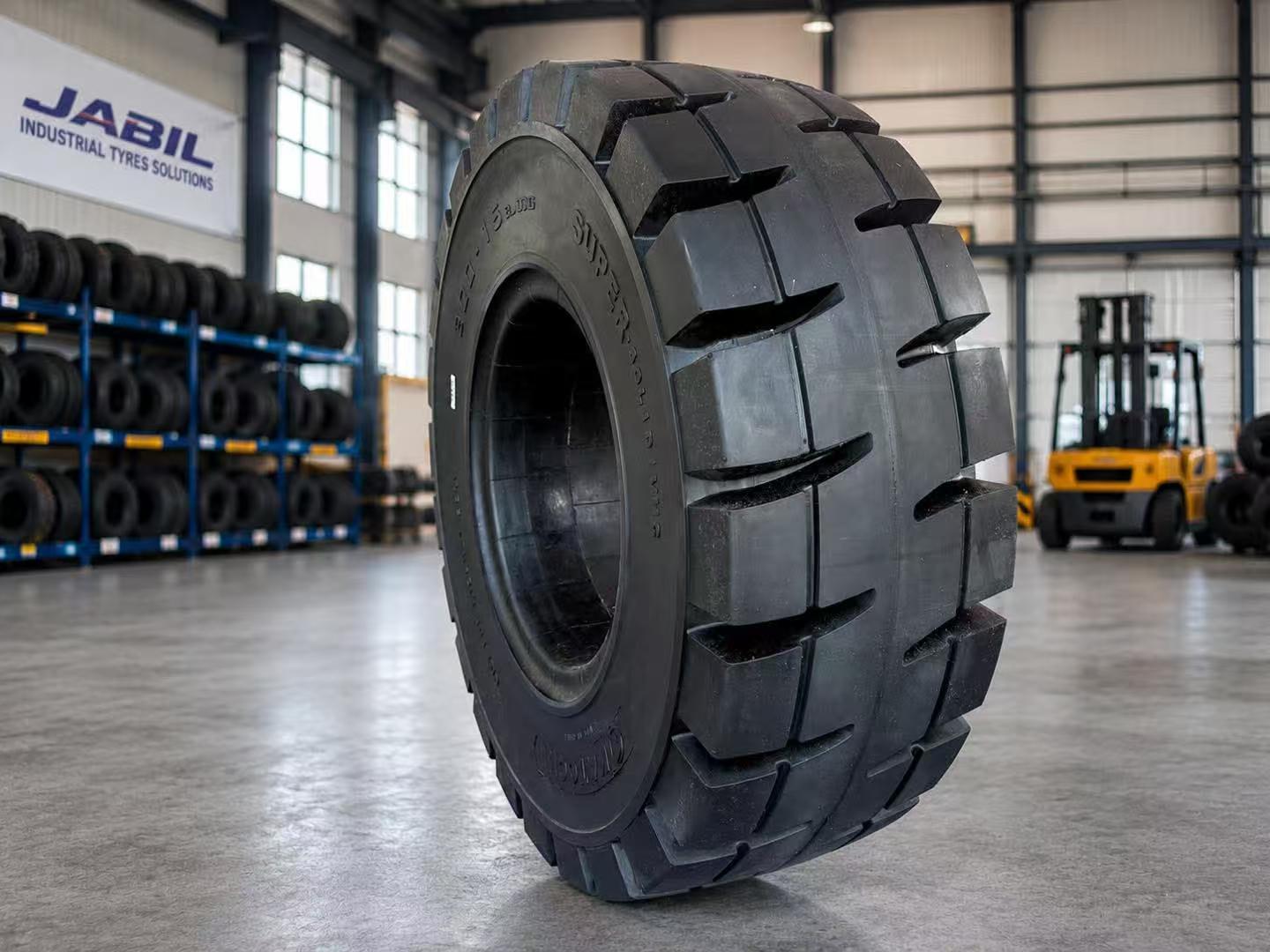
Natural rubber — the main raw material in solid tyres — has risen about 14% since the start of 2026, and tyre makers worldwide have announced 2–5% price increases. Here is what is driving it, how it reaches your quotation, and four practical ways to protect your margin.
The Short Answer: Raw Materials, Not Margins, Are Driving 2026 Price Notices
If you have received a price-increase notice from your tyre suppliers this year, the cause is upstream: natural rubber, the largest cost item in a solid tyre compound, has risen about 14% since January on the Chinese spot market, with futures briefly touching RMB 18,800 per tonne — a two-year high. The World Bank expects the benchmark TSR20 grade to average $1.90/kg in 2026, up 7.3% from 2025, and the ANRPC estimates global natural rubber supply will fall short of demand for the sixth consecutive year.
The industry response has been coordinated but measured: major tyre makers — including Michelin, Bridgestone and the largest Chinese manufacturers — have announced increases concentrated in the 2–5% range. When the largest players in an industry move together by a similar margin, it reflects raw-material cost being passed through, not individual suppliers taking extra margin.
The Key Numbers at a Glance (September 2026)
These are the figures behind this year’s price notices, each with its source so you can verify them independently:
- TSR20 natural rubber world average: $1.90/kg forecast for 2026, up 7.34% from $1.77/kg in 2025 (World Bank Commodity Outlook, April 2026)
- China spot natural rubber: RMB 17,900/tonne in early September, up about 14% year-to-date — a two-year high (SunSirs market data, September 2026)
- Shanghai rubber futures main contract: intraday peak of RMB 18,800/tonne (September 2026)
- Thai raw materials at origin: smoked sheet THB 95.00/kg (+38.7% year-on-year), field latex THB 88.50/kg (+56.0%), cup lump THB 74.80/kg (+34.8%) (ANRPC/SunSirs, June 2026)
- Global supply-demand balance: a deficit of up to 400,000 tonnes expected in 2026 — the sixth consecutive deficit year (ANRPC, February 2026)
- Announced tyre price increases by major makers: 2–5%, rolling out since Q1 2026 (company notices: Michelin, Bridgestone, Zhongce, Sailun)
Supply Keeps Falling Short — for the Sixth Year Running
The ANRPC expects global output of roughly 15.2–15.3 million tonnes in 2026 against demand of about 15.6 million tonnes. Several structural problems sit behind that gap:
- Fungal leaf-fall disease has spread across producing countries, with yield losses reported at 30–35% in affected plantations
- Ageing trees and limited replanting: low prices through the mid-2010s discouraged farmers from reinvesting, and output from older plantations keeps declining
- Land-use change: in some regions, farmers have switched to oil palm and other crops
- Weather risk: an El Niño event confirmed in 2026 raises the probability of drought in Southeast Asian tapping regions in the second half of the year
Demand Keeps Growing, and Synthetic Rubber Is No Relief Valve
Global natural rubber demand is projected to grow about 1.7% in 2026, led by China and India. Tyre manufacturing accounts for nearly two-thirds of natural rubber consumption, and heavy-vehicle and material-handling segments have been the strongest part of that demand.
Normally, buyers could switch to synthetic rubber when natural rubber gets expensive. That escape valve is closed this year: butadiene, the key feedstock for synthetic rubber, has been in short supply and has pushed synthetic rubber prices to record levels. Downstream manufacturers are actually shifting more of their compound toward natural rubber — adding further pressure to exactly the material used in solid tyres.
How Rubber Costs Reach Solid Tyre Prices
A solid tyre is not a single block of rubber — it is a layered product using a natural-rubber-rich tread, a cushion and bonding layer, and a hardened base compound, plus steel reinforcement depending on the type. Natural rubber and carbon black are the two largest cost items, so a sustained rise in rubber feeds directly into factory cost per piece.
Two things matter when you read a supplier’s price notice this quarter. First, the increase is industry-wide: Michelin, Bridgestone, Zhongce Rubber and Sailun have all issued notices in 2026, mostly in the 2–5% range. Second, announced increases remain below the actual rise in compound cost — as several Chinese manufacturers stated in their notices, factories are absorbing part of the increase to stay competitive. That points to cost pass-through rather than opportunistic pricing.
What Buyers Can Do Now
Four actions reduce your exposure to the next price review:
- Lock volumes before the next adjustment window — most factories review prices quarterly; if your Q4 consumption plan is known, order before the next review date
- Consolidate sizes and book full containers — mixed-container loading of your regular sizes improves the factory’s production run and trims per-unit cost, offsetting part of a 3–5% material increase
- Use framework agreements with fixed validity — ask for written quotation validity (15–30 days is standard) or a quarterly framework price so your landed-cost planning stays stable
- Do not trade quality for a headline price — in a rising-cost cycle, unusually low quotes usually mean thinner tread rubber or lower rubber content; for solid tyres on multi-shift duty, cost per operating hour matters more than price per piece
The last point matters most on natural-rubber-rich products such as deep-lug and shock-absorption patterns — the 28x9-15 solid tyre page shows how a heavy size publishes its full compound-relevant data, so comparisons stay honest.
Frequently Asked Questions
Short answers to the questions buyers are asking this quarter:
- How much have solid tyre prices risen in 2026? Announced increases from major makers are concentrated in the 2–5% range, in line with raw-material cost moves; actual quotes vary by size, compound and volume.
- Will rubber prices come back down soon? Most institutions expect firm prices through 2026: the supply deficit is structural (disease, ageing trees) and El Niño adds second-half risk; short-term dips during peak tapping season are possible but the overall level is higher than a year ago.
- Is now a good time to buy for the full year? If your Q4–Q1 consumption is forecastable, locking volume at current validity protects you from the next review; split large orders into 2–3 shipments to stay lean while securing today’s price.
- Which products are most affected? Natural-rubber-rich compounds — deep-lug OTR and shock-absorption forklift tyres — carry the highest NR content; smaller press-on and PU-based products are less exposed.
Get Current Pricing
JABIL supplies solid forklift tyres, press-on tyres, OTR solid tyres and PU wheels from its factory in Dongying, China, with factory-direct pricing and OEM options. Send your size list and we will confirm current pricing, quotation validity and loading quantities within one business day — start from the quote page or browse the forklift solid tyre size charts first.
Sources
All figures in this article come from public, citable sources:
- World Bank, Commodity Markets Outlook, April 2026 (TSR20 price forecast)
- ANRPC supply-demand statement, February 2026, and ANRPC/SunSirs market commentary, June 2026
- Chinese commodity market data via SunSirs, June and September 2026
- Public price-increase notices from Michelin, Bridgestone, Zhongce Rubber and Sailun, 2026
Have questions about your specific application?
Frequently Asked Questions
Why have solid tyre prices risen?
Natural rubber, carbon black and freight have all moved, and tyre prices follow the input cost of the heaviest material — rubber. Because a solid tyre is almost entirely rubber compound, price movements hit solid tyres harder than they hit most other industrial products.
How long is a tyre quotation valid?
A quotation is only as firm as the raw-material window behind it. Ask for an explicit validity period and treat it as real: a quote without a validity date is an invitation to renegotiate at the worst moment.
How can buyers reduce the impact of price rises?
Order in larger, less frequent batches where storage allows, standardise on fewer sizes and compounds, and place orders before announced increases rather than after. Volume and mix discipline do more for cost than hard negotiation alone.
Are cheaper tyres actually cheaper?
Not always. A lower-priced tyre that wears faster, chunks earlier or fails to hold a load can cost more per operating hour than a correctly specified one. Compare on cost per hour of service, not on unit price.
Does JABIL hold quoted prices?
For a stated validity period, yes. Send the size, quantity and destination and we will quote with an explicit validity window so you can plan rather than guess.