
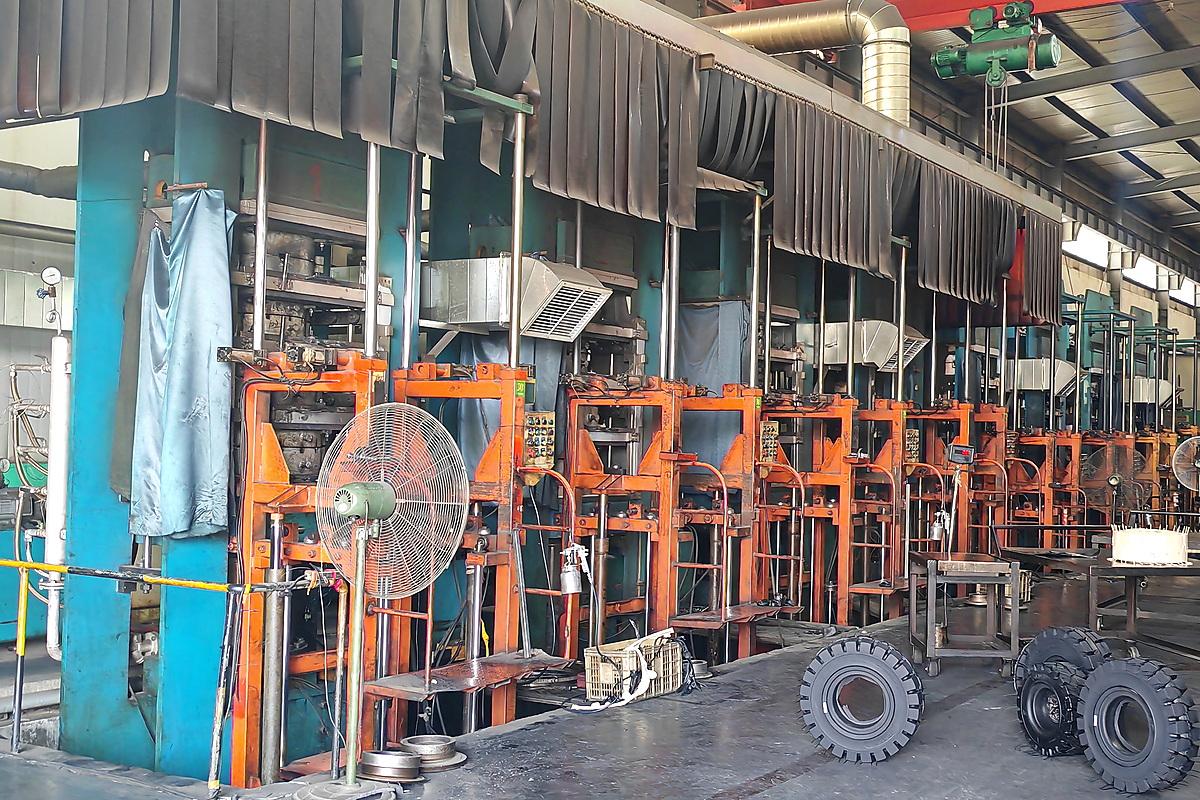
Quick answer: before placing a first solid tyre order, verify ten things — factory registration and export licence, real production equipment, compound formulation disclosure, batch-level QC reports (hardness, dimensions, weight), curing records, sample testing, capacity against your volume, OEM capability, trade terms, and after-sales claim handling. Most quality failures trace back to steps 2, 4 and 6 — skipping a site check, accepting catalogue certificates instead of batch reports, and not testing samples from the actual production line.
Why First Orders Fail — and Where the Blame Actually Sits
Importers who source solid forklift tyres from China usually lose money in one of three ways: a compound that chunks or cracks within weeks in their customer's application, inconsistent dimensions across batches that make mounting difficult, or a shipment that looks fine in the container but arrives with cosmetic damage and no paperwork to support a claim. All three failures trace back to the same root cause — the buyer evaluated a supplier by price, certificates and photos instead of by auditable facts.
This checklist is written for first-time orders from a new supplier, and it works whether you are an importer stocking a warehouse or a dealer consolidating for end users. It takes one factory visit or one video call plus a document request to complete — a day of work that protects an order worth ten times the effort.
Points 1–3: Is This a Real Factory?
The single most expensive mistake in Chinese tyre sourcing is buying from a trading company that presents itself as a manufacturer. Trading companies are not automatically bad — some add value in consolidation and communication — but when they present as a factory, you lose traceability: nobody on the call can answer why a batch cured short, because nobody saw the press.
- Business licence and scope. Ask for the company's business licence and check that the registered scope includes tyre manufacturing, not just "international trade". Cross-check the registered address against the factory address they quote — a mismatch is normal for sales offices, but you should know which building produces your tyres.
- Equipment you can verify. Ask for photos or a live video walkthrough showing the mixing (banbury) line, the curing presses with your tyre moulds in them, and the finished-goods area. A real solid tyre plant will show presses of 10+ tonnes and moulds by size. Stock-video footage or render images are a red flag.
- Export track record. Ask which markets they ship to now and for two reference customers you may or may not contact. A supplier exporting to the EU or North America already handles documentation, and their compound portfolio will reflect those markets' non-marking and low-heat requirements.
Points 4–6: What Quality System Actually Runs on the Line
This is where most audits go soft. Buyers accept an ISO certificate and move on — but an ISO certificate says a system exists, not that it was followed for your batch. What you want is batch-level evidence.
- Batch QC reports. Require, per production batch: Shore A hardness, overall diameter and section width measurements, and weight. Hardness variance within a batch of more than ±3 Shore A points signals inconsistent mixing. Insist the report carries the batch number that is printed on your tyres.
- Curing records. For the sizes you order, ask how cure time and temperature are logged per press. Handwritten logs are fine — an unreadable process is what kills consistency, not paper.
- Sample testing from real production. Order samples cut from current production, not showcase pieces. Test them in your hardest application before committing volume: a customer's scrap yard will reveal compound weakness in three weeks that a warehouse will not reveal in three months.
JABIL Technical Note
JABIL supplies batch-level QC documentation — hardness, dimensional checks and non-marking test reports — with every shipment as standard. See the manufacturing and QC overview for the full documentation set.
Points 7–8: Capacity, OEM and the Compound Question
Once the factory is real and the quality system is credible, two commercial questions remain.
- Capacity against your volume. Ask monthly output for your specific sizes, not the plant total. A plant producing 200,000 tyres a month may still only make 3,000 of your size, and if your annual need is 20,000 of that size you have just found your delivery-delay cause before it happens. Confirm the mould situation: does the factory own the moulds for your sizes, or are they borrowed from a neighbour plant?
- OEM and branding capability. If you sell under your own brand, verify sidewall marking (white letters, custom logo), packaging and pallet labelling with a photo of a real previous OEM run — not a mock-up. Minimum quantities for OEM marking vary widely; get the number in writing before you price your own catalogue.
Points 9–10: Trade Terms and When Something Goes Wrong
The last two points decide how a relationship behaves under stress. First, trade terms: confirm price validity in writing — raw material costs are volatile (natural rubber and carbon black move together), and a supplier who holds a quoted price for 30 days is easier to build a catalogue around than one who reprices weekly. Confirm Incoterms, container utilisation ( tyre volume per 20ft container at your sizes), and payment terms against your cash cycle.
Second, claims handling. Ask directly: "When a customer reports chunking at three months, what happens?" A serious supplier has a defined claim process — photo evidence, retained batch samples, and a repair/replacement/credit decision path. A supplier who answers "don't worry, quality is very good" has just told you the audit failed at the most important question. Put the claims window and evidence requirements in the purchase contract, not in an email promise.
The 60-Second Version
For buyers who want the checklist as a copy-paste enquiry:
- Business licence + registered scope covers manufacturing
- Video walkthrough: mixing line, curing presses, finished goods
- Current export markets and two references
- Batch QC reports: hardness, OD/section width, weight, per batch number
- Cure time/temperature logging per press
- Samples from current production, tested in your worst application
- Monthly capacity for your sizes + mould ownership
- OEM sidewall marking, packaging, MOQ in writing
- Price validity window, Incoterms, payment terms
- Written claims process with evidence requirements
Ten answers, one day of work. When you are ready to run the checklist against a real supplier, request our documentation set and we will send the batch QC report pack, capacity sheet and OEM terms for your size list — or browse the forklift solid tyre range to start from the specifications.
Have questions about your specific application?
Frequently Asked Questions
How do I verify a solid tyre supplier is a real factory, not a trading company?
Ask for the business licence and check the registered scope covers tyre manufacturing, request a live video walkthrough showing the mixing line and curing presses with actual tyre moulds, and ask which export markets they currently ship to with two references. A trading company presenting as a factory typically cannot show real presses or answer questions about cure logs.
What QC documents should I require with each solid tyre shipment?
Batch-level reports tied to the batch number printed on your tyres: Shore A hardness, overall diameter and section width measurements, and weight per batch. Hardness variance beyond about ±3 Shore A points within a batch signals inconsistent mixing. Catalogue-level ISO certificates alone do not prove the batch you received was checked.
Should I test samples before placing a full solid tyre order?
Yes, and the samples must come from current production rather than showcase pieces. Test them in your hardest application — a scrap yard or steel mill will reveal compound weakness in weeks where warehouse use will not. Testing in the real application is the single cheapest way to avoid a container of tyres that chunks in your customer's hands.
What should be in the purchase contract for first-time solid tyre orders?
Price validity window (30 days is standard given raw material volatility), Incoterms, payment terms, OEM marking and packaging requirements with MOQ, and a written claims process: evidence requirements, retained batch samples, and a defined replacement or credit path. Verbal promises about quality have no value once the container is unloaded.