
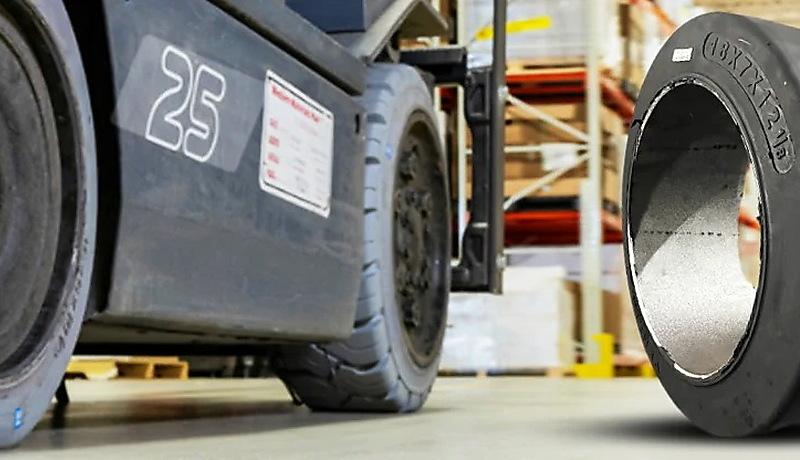
Press-on tyres mount directly to the metal hub without a separate rim. This article explains the sizing convention, mounting process, and key differences between standard and non-marking compound options.
What Is a Press-on (Cushion) Tyre?
A press-on tyre — also called a cushion tyre or band tyre — is a type of solid tyre that is pressed directly onto a steel wheel hub. Unlike conventional solid tyres (which require a multi-piece rim with flanges), press-on tyres use a steel band that is bonded to the rubber compound and pressed onto the hub under hydraulic force.
The result is a very compact wheel assembly with no separate rim components. Press-on tyres are standard on most electric sit-down counterbalance forklifts and some order pickers.
Reading the Press-on Tyre Size
Press-on tyre sizes use a three-dimension format: overall diameter × section width × inner diameter, all measured in inches (with fractional notation for older sizes).
Examples: 18×6×12 1/8 — 18 inches overall diameter, 6 inches section width, 12 1/8 inches inner diameter (the steel band inner diameter that presses onto the hub). Take the 15x5x11¼ press-on tyre: three numbers, three physical facts — outer diameter, tread width, and the steel band diameter that must match the wheel.
- 15×5×11 1/4 — common on small 1-tonne electric sit-down forklifts
- 18×7×12 1/8 — common on 1.5–2 tonne electric sit-down forklifts
- 21×8×15 — common on 2.5–3 tonne electric sit-down forklifts
- 22×9×16 — common on 3 tonne electric forklifts
- 23×10×16 — for heavier 3.5–4 tonne models
- 28×12.5×22 — for large 6+ tonne electric forklifts
The Mounting Process
Press-on tyre installation requires a hydraulic press. The tyre is positioned over the hub and pressed on under controlled force — typically 10–30 tonnes depending on tyre size. The steel band interference-fit ensures the tyre stays securely on the hub under all load conditions.
Unlike conventional solid tyres (which can be changed in the field with a multi-piece rim), press-on tyres require a hydraulic press for both fitting and removal. This means tyre changes are usually carried out at a tyre service workshop rather than on-site. For the most common size in the range, the 18x7x12⅛ press-on tyre page shows what a ready-to-order specification looks like.
Standard vs. Non-Marking Compound
Press-on tyres are available in both standard black rubber compound and non-marking white compound. The selection criteria are the same as for conventional solid tyres:
- Standard black — suitable for most warehouse and logistics environments on smooth concrete
- Non-marking white — required in food, pharmaceutical, and clean-floor environments where tyre marks are unacceptable
JABIL Technical Note
JABIL supplies press-on tyres in both compounds for all standard sizes. The non-marking white variant carries the same load ratings as the standard black compound.
How to Specify When Ordering
When ordering press-on tyres, provide the following information:
- Full tyre size: e.g. 18×7×12 1/8 (all three dimensions)
- Compound: standard black or non-marking white
- Machine make and model (helps confirm the correct inner diameter tolerance)
- Quantity per order and required delivery schedule
When you have the three numbers, a 21x8x15 press-on tyre quotation request takes one form submission — compound and quantity complete the order.
Have questions about your specific application?
Frequently Asked Questions
What is a press-on tyre used for?
Press-on tyres are used on cushion-tyre forklifts, reach trucks, order pickers and other indoor electric trucks, where the tyre is bonded to a steel band and pressed onto the hub rather than mounted on a rim.
How do I measure a press-on tyre?
Read all three dimensions: overall diameter, section width and band diameter. A size such as 18×7×12 means 457 mm diameter, 178 mm width and a 308 mm band. All three must match the machine.
Can I fit press-on tyres myself?
Only with a suitable hydraulic press and the correct procedures. Many customers order tyres pre-mounted on wheels instead, which removes the pressing step and the risk of damaging a band during fitment.
What causes press-on tyres to fail early?
Wrong band diameter forcing an incorrect press fit, running past the wear limit, working outside the compound’s temperature range, and contamination such as oil attacking the bond. Correct specification prevents most premature failures.
Do press-on tyres come in non-marking compound?
Yes, in most sizes, made to order. Non-marking is common in food, pharma and clean logistics sites where a black scuff on a finished floor is a real cost.