
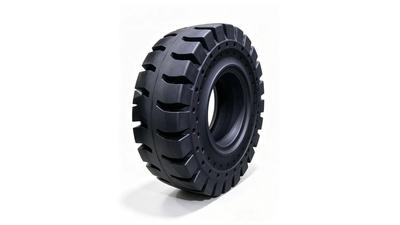
The per-unit price is the least useful number in an OTR tyre decision. Here is the cost-per-hour model scrap yards and steel mills can run before they buy, and the four site numbers it needs.
Ask two suppliers for an OTR tyre price and you will get two numbers that look comparable and are not. One is a pneumatic tyre that costs less per unit and will be replaced three or four times before the machine is retired, with an unknown number of unscheduled stoppages in between. The other is a solid tyre that costs roughly twice as much, arrives heavier, rides harder, and may last the life of the machine.
Comparing those two numbers directly is how fleets end up buying the cheaper tyre every year and never quite understanding why maintenance costs keep climbing. The honest comparison is cost per hour of machine operation, and it is a calculation any buyer can run in ten minutes with four numbers from their own site.
The Three Costs That Belong in the Comparison
A tyre decision has three cost components, and most quotations only mention the first:
- Tyre cost per unit, multiplied by how many you will consume over a defined period. Four pneumatics over 8,000 hours is a different number from one solid over the same period.
- Fitting cost per change: labour hours, mounting equipment, and the machine time lost while the wheel is off.
- Downtime cost per unscheduled failure: the machine hour rate multiplied by the hours the machine sits idle, plus any knock-on cost such as a blocked working lane, an idle operator or a missed loading window.
Add those three and divide by the hours the machine actually works. That is the only figure that can be compared across tyre types, because it puts a price on the thing solid tyres are actually better at: not puncturing.
A Worked Example, With Round Numbers
Set the pneumatic tyre price at 1.0 and the equivalent solid at roughly 2.0 to 2.5 times that. The exact multiple depends on size and compound, but the ratio is stable enough to reason with. Now add the two costs that never appear on a quotation.
Take a loader in a scrap yard: machine hour rate of 60, a pneumatic life of 2,000 hours in that environment, and two unscheduled flats per 1,000 hours, each costing four hours of machine time plus two hours of fitting. Per 2,000 hours the pneumatic consumes one tyre plus two flats: one tyre cost, twelve hours of fitting labour, and eight hours of machine downtime. The solid tyre costs 2.2 tyres but lasts the full 2,000 hours with no flats.
Put numbers on the downtime alone: eight hours at 60 per hour is 480, which is already close to the price of the pneumatic tyre that caused it. The solid tyre does not need to win on wear life to win the comparison. It wins because the events that generate those 480 do not happen.
JABIL Technical Note
These are illustrative figures, not a quotation. Substitute your own tyre price, your own machine hour rate and your own failure history, and the model will give you your own answer.
Why Solid Wear Life Is Not Simply a Multiplier
The mistake in most spreadsheets is assuming a solid tyre lasts a fixed multiple of a pneumatic. It does not, because the failure modes are different. A pneumatic in a scrap yard rarely reaches its wear limit; it is removed by a sidewall cut, a bead that will not seal, or a puncture. A solid tyre has no air to lose and no bead seal to protect, so its life is decided by tread wear and internal heat instead.
That means the comparison changes with the site. On a clean concrete apron where pneumatics survive, the solid tyre wins on wear life alone and the multiple is modest. In a shredder yard full of sharp steel, the pneumatic does not wear out at all, and the multiple becomes irrelevant because the tyre is destroyed long before it is worn.
This is also why asking a supplier for a guaranteed hour figure is the wrong question. Ask what failure mode the compound and tread were specified for, and whether that matches what is actually destroying tyres on your site.
When Pneumatics Are Still the Right Answer
Solid tyres are not automatically better, and a supplier who says otherwise is selling rather than specifying. There are three situations where a pneumatic remains the correct choice and should stay on the machine.
First, high-speed transport work over long distances: solid tyres run hotter and ride harder, and on a machine doing long road-speed laps the heat penalty outweighs the puncture benefit. Second, machines where the suspension is the tyre: some older loaders and haulers rely on sidewall flex for ride quality and structural protection, and fitting solids can transfer shock into the machine frame. Third, low-risk sites where punctures are genuinely rare and a pneumatic will wear out normally, which is a large share of quarries and yards with prepared surfaces.
The decision is per machine, not per site. Most mixed fleets we quote end up running solids on the yard and short-cycle machines and keeping pneumatics on the machines that leave the yard. That is a rational outcome, and it is what the cost-per-hour model will tell you if you run it machine by machine instead of site-wide.
The Four Numbers You Need From Your Own Site
Before asking for a quotation, collect these. Without them any comparison is guesswork:
- Typical tyre life in hours on the current tyre, taken from your maintenance records rather than from a datasheet.
- Unscheduled tyre events per 1,000 machine hours, and what each one costs in machine time and labour.
- Machine hour rate: what an hour of that machine being unavailable actually costs you, including operator and downstream effects.
- Duty cycle: load per wheel, distance per shift and average speed. Heat, not load, is usually the limit on solid tyres, and speed is what generates it.
Two of those four numbers are almost always missing when a buyer first asks for a price. They are also the two that decide the answer.
What a Good Quotation Should Contain
A tyre quotation that only lists sizes and prices is not a specification. For OTR work it should also state the compound recommendation and the reason for it, the load rating at your actual speed rather than a single headline figure, the rim and fitment requirements, and the expected wear life in hours with the assumption behind it.
If a supplier cannot explain why a particular compound was chosen for your site, the quote is a catalogue lookup and you should treat the wear-life figure accordingly. The technical questions worth asking before you commit are covered in our guide to where pneumatic OTR tyres fail on ports, scrap yards and steel mills, which explains the failure modes this model is pricing.
Working With JABIL
JABIL Rubber Co., Ltd. manufactures industrial solid tyres and OTR solid tyres in Guangrao County, Dongying City, Shandong, under an ISO 9001:2015 quality management system, with more than 1,000 size specifications across six product categories and exports to more than 50 countries.
For OTR enquiries we size against the duty cycle rather than the tonnage alone: deep-lug and standard patterns, compound selected for the site conditions, industrial rims supplied alongside the tyres so fitment is one procurement instead of two. Minimum order is 20 pieces per size, with mixed sizes consolidated in one container.
Send the four site numbers above, or simply the machine list, current tyre size and a description of what the ground is made of, and our engineers will come back with a specification, load data and a cost-per-hour indication rather than a price list.
Specifications referenced in this guide
Size and product pages with the published rim, dimensions and load data discussed above.
Have questions about your specific application?
Frequently Asked Questions
How do you compare solid and pneumatic OTR tyre costs fairly?
Compare cost per machine hour, not cost per tyre. Add the tyre price, fitting labour and the cost of unscheduled downtime, then divide by the hours the machine actually works. A tyre that costs twice as much but removes flats often wins that calculation, and the only way to know is to run it with your own site numbers.
How long do solid OTR tyres last compared with pneumatic tyres?
There is no fixed multiple. On clean prepared surfaces a solid tyre usually reaches its wear limit and lasts substantially longer than a pneumatic. In shredder yards and slag areas a pneumatic rarely reaches its wear limit at all, because it is destroyed by sidewall cuts or punctures first, which changes the comparison entirely. Ask what failure mode the tyre is specified against rather than for a guaranteed hour figure.
What is the machine hour rate and why does it matter for tyre choice?
It is what an hour of that machine being unavailable costs you, including the operator, the blocked working lane and any downstream delay. It is the number that makes downtime visible in a purchasing decision. Without it, an eight-hour stoppage looks like a maintenance annoyance instead of a cost larger than the tyre that caused it.
Are solid tyres always better in scrap yards?
No. Solid tyres are the right answer where sharp debris destroys pneumatics faster than they wear, and where downtime is expensive. On machines doing long high-speed laps the extra heat and harder ride can outweigh the puncture benefit, and on older machines that rely on sidewall flex for ride quality, fitting solids can transfer shock into the frame. The decision is per machine, not per site.
What information should an OTR tyre quotation include besides price?
The compound recommendation and the reason for it, the load rating at your actual working speed rather than a single headline figure, the rim and fitment requirements, and an expected wear life in hours with the assumption stated. A quotation that lists only size and price is a catalogue lookup, not a specification.