
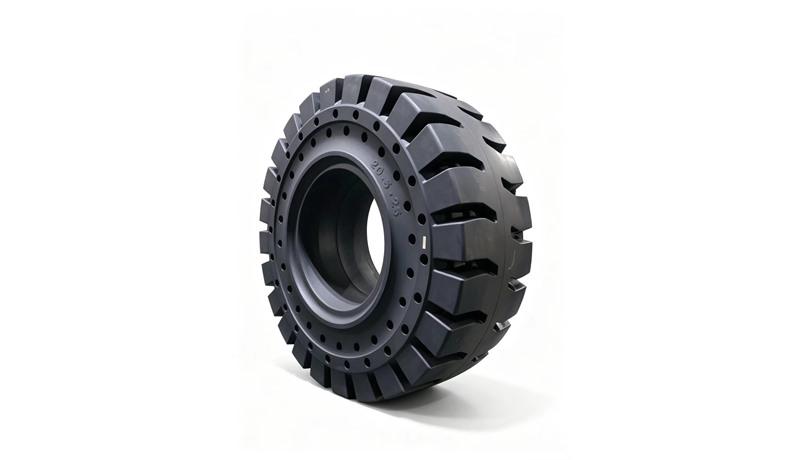
Port terminals, scrap yards and steel mills destroy pneumatic OTR tyres from the sidewall in. Here is how solid OTR construction changes the downtime math, and what to check before you specify.
Most buyers come to solid OTR tyres the same way. They have wheel loaders, reach stackers or slag carriers running on pneumatic tyres, and they are tired of the same failure repeating: a sidewall cut from scrap or slag, a bead that will no longer seal, or a puncture that puts a machine down for a day in the middle of a vessel operation or a furnace campaign.
A pneumatic OTR tyre is a pressure vessel. Its whole job depends on keeping air inside a flexible casing, and everything that makes it comfortable on rough ground — the flexible sidewall, the captive air, the open tread — is also what makes it fragile in environments full of sharp steel. Solid OTR tyres remove the air cavity entirely. That single change rewrites the failure modes, and with them the maintenance and downtime math for the whole site.
Where Pneumatic OTR Tyres Fail First
On the sites this article covers, pneumatic tyres almost never wear out in the conventional sense. They are killed by the environment, and usually from the sidewall, not the tread:
- Sidewall cuts from scrap, slag and cargo debris. A cut deep enough to expose cords ends the tyre immediately, because the casing can no longer hold pressure safely.
- Bead and rim damage from repeated impacts against rails, quay edges and furnace aprons. Once the bead area is compromised, the tyre will not seat or seal reliably again.
- Multi-plate rim failures on loaders working in impact-heavy zones, which take the wheel out of service along with the tyre.
- Puncture downtime that arrives without warning. A loader with a flat is not a small repair on a port apron; it is a machine blocking a working lane during vessel operations.
- Pressure management labour. Large OTR pneumatics need regular pressure checks and top-ups; on busy sites that routine quietly slips, and under-inflation accelerates every other failure on this list.
None of these are maintenance failures in the usual sense. They are the expected outcome of putting a pressure-dependent product into an environment designed to cut, crush and puncture things.
What Solid Construction Changes About the Downtime Math
A solid OTR tyre has no air cavity to lose. Puncture resistance is not a feature of the compound; it is a property of the construction. A cut in the rubber is still damage, but it is rarely a stoppage — the machine keeps working until the tyre reaches its wear limit.
That changes the economics in three ways. First, unplanned downtime collapses: the failures that used to stop machines mid-shift are mostly gone. Second, the maintenance routine simplifies: no pressure checks, no bead inspections for sealing, no emergency roadside repairs with heavy-duty jacks and gantries. Third, fleet planning becomes predictable: solid tyres wear progressively, so replacement can be scheduled against measured tread wear instead of reacting to sudden failures.
The trade-off is honest and should be stated plainly: solid tyres are heavier than equivalent pneumatics, ride harder, and cost more per unit. They earn their place on machines where downtime and safety exposure outweigh ride comfort — which is exactly the profile of port, scrap and steel applications.
Duty Cycle by Site: What Each Environment Demands
The three environments buyers usually ask about stress a tyre differently:
- Port terminals and intermodal yards: long travel distances on concrete or asphalt between quay, yard and gate, mixed with rail edges, dock plates and cargo debris. The priorities are heat resistance over distance, cut protection around rail lines, and stable handling for reach stackers and empty handlers.
- Scrap yards and recycling plants: the most cut-hostile environment in the industry. Shredded steel, compressed car bodies and shear offcuts attack the tread and sidewall continuously. Tread depth and compound cut resistance dominate the specification; speed is usually low.
- Steel mills and slag handling: extreme heat exposure from slag, splatter and hot mill floors, plus impact loads from ladle and slag carriers. Compound heat resistance and a deep, self-cleaning tread matter more than anything else.
A quarry or cement plant loader has yet another profile — abrasive rock rather than sharp steel — but the pattern is the same: the site picks the failure mode, and the specification should answer that specific failure mode rather than a generic "heavy duty" label.
Choosing the Tread: Deep Lug, Standard Lug or Smooth
On loose, soft or contaminated ground — slag heaps, scrap floors, mud and gravel — a deep lug tread does two jobs at once. It bites into an unprepared surface for traction, and its self-cleaning action sheds the material that would otherwise pack the tread and turn it into a smooth, sliding block.
On hard prepared surfaces such as port aprons, deep lugs are not automatically better. A shallower lug or a smoother tread lowers rolling resistance, runs cooler over long distances, and typically wears more evenly on concrete. Matching tread depth to the actual surface — not defaulting to the most aggressive pattern available — is one of the easiest wins in OTR specification.
For buyers who need a starting point, our deep-lug OTR solid tyre was developed exactly for this split: deep lug traction for loose ground, slag and debris, with the solid construction removing the puncture failure mode entirely. See the product page for sizes and load data, and the OTR category page for the wider range.
Heat Is the Real Limit, Not the Load
Solid tyres generate internal heat as the rubber flexes, and they shed that heat more slowly than pneumatics because there is no air cavity to ventilate the casing. Internal heat build-up is the mechanism behind most solid tyre failures that are not caused by cuts: the compound overheats, and the tyre separates or tears from the inside.
This is why duty cycle matters as much as static load. A loader creeping through a scrap yard can carry a heavier tyre than the same tyre would survive running long laps of a terminal at speed. When you specify, tell your supplier both numbers: the load per wheel and the distance and speed of the typical duty cycle. A supplier who only asks for tonnage is sizing half the problem.
Ambient and surface heat add on top. Slag lines and hot mill floors push the tyre temperature from below as well as above, which is why steel mill applications should always be flagged explicitly so the compound can be selected for it.
Rims and Fitment: What to Check Before You Order
Solid OTR tyres are only as good as the wheel they sit on. Before ordering, check the rim condition and profile against the tyre specification, and verify the wheel fastening condition on machines that have seen years of impact loading. A rim that is worn, out of profile or cracked at the bolt holes will undo the benefits of the best tyre compound.
For machines where impact damage has been chronic, it is worth reviewing the wheel and rim assembly as part of the tyre decision rather than after it — in severe environments many operators move to more robust rim arrangements at the same time as they switch to solid tyres. JABIL supplies industrial rims alongside its tyre range, so fitment can be specified as one package instead of two separate procurements.
What to Send Your Supplier for a Correct Quotation
A quotation that comes back with the right product the first time is a function of the information you send. For solid OTR tyres, include:
- Current tyre size and type marking read off the sidewall (size, ply or index marking, rim designation).
- Machine make and model, and the tyre function: drive, steer or both.
- Maximum load per wheel — weighed or from the machine data sheet, not estimated.
- Ground surface description: concrete, asphalt, slag, scrap floor, gravel or mixed.
- Duty cycle: typical distance and speed per shift, and the share of the day under load.
- Known failure history with the current tyres: cuts, heat separation, bead issues, uneven wear.
- Photos of the tyre fitted, the tread, and any visible failure damage.
Three Specification Mistakes That Shorten Solid OTR Tyre Life
Most premature solid OTR failures we see trace back to one of three mistakes, all avoidable at the quotation stage:
- Specifying on machine weight alone. Load per wheel — not machine tonnage — decides the tyre, and drive wheels carry more than steer wheels on the same machine.
- Quoting the size but not the duty cycle. A tyre correct for a static scrap handler will overheat running terminal laps at speed, and the failure will look like a compound problem when it is a duty cycle problem.
- Copy-fitting the tread pattern. Ordering the most aggressive lug available sounds safe, but on prepared concrete it runs hotter and wears unevenly. Match the tread to the surface the machine actually works on.
All three mistakes are removed by the quotation checklist in the previous section. Send the load per wheel, the surface and the duty cycle, and the specification answers itself.
Working with JABIL
JABIL Rubber Co., Ltd. manufactures industrial solid tyres and OTR solid tyres in Guangrao County, Dongying City, Shandong, under an ISO 9001:2015 quality management system, with more than 1,000 size specifications across six product categories and exports to more than 50 countries.
For OTR enquiries we size against your duty cycle, not just your tonnage: deep-lug and standard patterns, compound selected for the site, and OEM sidewall branding on request. Minimum order is 20 pieces per size, with mixed sizes consolidated in one container. Send your machine data and site description through the quote page and our engineers will come back with a specification and load data rather than a catalogue number.
Specifications referenced in this guide
Size and product pages with the published rim, dimensions and load data discussed above.
Have questions about your specific application?
Frequently Asked Questions
Are solid OTR tyres suitable for wheel loaders?
Yes, for loading duty in cut- and heat-hostile sites such as scrap yards, slag lines and port aprons. Solid OTR tyres are heavier and ride harder than pneumatics, so the machine specification, loader arms and counterweight should be checked with your supplier before conversion. On machines where downtime from cuts and punctures dominates the cost base, the trade is usually clear.
What information do you need to quote a solid OTR tyre correctly?
The tyre size and type marking read off the sidewall, machine make and model, maximum load per wheel, ground surface description, typical duty cycle with distance and speed per shift, failure history with the current tyres, and photos of the fitted tyre and any damage. Load per wheel and duty cycle are the two details buyers most often leave out, and both change the specification.
Do solid OTR tyres need special rims?
They fit on rims of the correct profile and condition, and the rim should be inspected before conversion because years of impact loading can leave rims worn, out of profile or cracked at the bolt holes. JABIL supplies industrial rims alongside its tyre range, so wheels and tyres can be specified as one package rather than two separate procurements.
How long do solid OTR tyres last compared with pneumatics?
In cut-hostile environments the comparison is not close: pneumatics typically die early from sidewall cuts, bead damage or punctures rather than wearing out, while solid tyres wear progressively to their wear limit and can be scheduled against measured tread wear. Actual life depends on load, surface, duty cycle and compound, which is why life should be forecast from tread measurements rather than calendar time.
What is the minimum order for solid OTR tyres?
At JABIL the minimum order is 20 pieces per size, with mixed sizes consolidated in one container. OEM sidewall branding and custom compound selection are available; send the machine data and site description through the quote page for a specification with load data.