
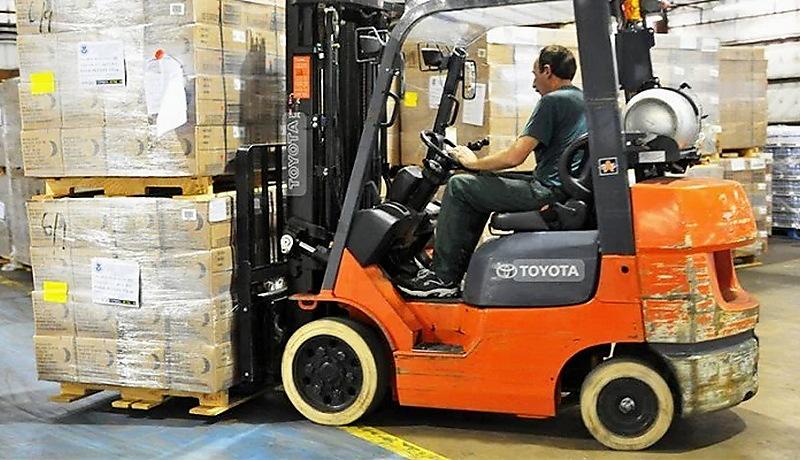
Non-marking tyres are essential in food processing, pharmaceutical, and clean-floor environments. We explain the compound differences, applications, and what to specify when ordering.
What Makes a Tyre "Non-Marking"?
Standard solid tyres use a carbon-black rubber compound that gives the tyre its characteristic black colour. When a standard tyre scuffs or skids on a smooth floor, it deposits microscopic carbon particles — creating the dark marks commonly seen in warehouse aisles and loading bays.
Non-marking tyres replace the carbon-black with silica and other light-coloured fillers. The result is a white or light grey tyre that leaves no dark deposit when operated on smooth surfaces. The compound is engineered to match or exceed the load capacity and abrasion resistance of standard black compound.
Where Non-Marking Tyres Are Required
Non-marking tyres are required — not just preferred — in the following environments: The most requested version in practice is the non-marking 18×7-8 forklift tyre, which fits the same trucks as the black standard.
- Food processing and packaging plants (floor hygiene requirements, contamination prevention)
- Pharmaceutical and medical device manufacturing (clean-room and GMP compliance)
- Beverage bottling and cold storage facilities
- Electronics and semiconductor assembly (clean environment requirements)
- Polished concrete or epoxy-coated warehouse floors (aesthetic and maintenance reasons)
- Retail distribution centres with public-facing areas
Non-Marking vs. Standard: Performance Comparison
A common concern is whether non-marking compound sacrifices durability for cleanliness. In practice, the differences are minor in most applications: Compound choices apply across the size range — see the 4.00-8 solid tyre compound options as an example of how the same decision looks at the small end.
- Load capacity: equivalent — JABIL non-marking tyres carry the same rated loads as their black counterparts
- Abrasion resistance: slightly lower on rough outdoor surfaces, but equivalent on smooth indoor floors
- Heat resistance: comparable, though non-marking compound may show slightly more surface wear at sustained high-cycle indoor operations
- Cost: non-marking variants typically carry a 10–15% price premium due to compound material cost
What to Specify When Ordering
When ordering non-marking tyres, confirm the following with your supplier:
- Tyre size (e.g. 18×7-8 or 23×9-10)
- Compound type: white or light grey (grey compound is commonly used for scissor lift tyres)
- Any specific shore hardness requirement
- Whether a test report or compound certification is required
- For press-on (cushion) tyres, confirm the band type and inner diameter
For electric counterbalance trucks, a 15x6-8 solid tyre in non-marking compound is a typical clean-floor order — size and compound are ordered together.
JABIL Technical Note
JABIL provides non-marking compound in both white and light grey for most standard sizes. Contact us to confirm availability for your specific size.
Have questions about your specific application?
Frequently Asked Questions
What is a non-marking tyre?
A tyre made from a compound that leaves no black scuff marks on finished floors. The rubber is formulated with non-staining ingredients rather than being a different colour applied over a black tyre.
Do non-marking tyres last as long as black tyres?
Typically slightly less, because the formulation trades some wear resistance for non-staining behaviour. In most clean-floor applications the trade is worth it, but the wear rate should be expected and planned for rather than discovered later.
Where are non-marking tyres required?
Food and beverage plants, pharmaceutical and medical sites, clean electronics production, hospitals, retail floors and modern logistics buildings with specified floor finishes. The requirement usually comes from the site standard, not from regulation.
Can any tyre be made non-marking?
Most standard solid and press-on sizes can be supplied in non-marking compound, normally to order because the formulation and minimum batch differ from standard black production.
How should I specify a non-marking tyre?
Give the size, the quantity and the site requirement, and confirm whether the whole fleet or only the clean-area trucks need the compound. Specifying the whole fleet non-marking when only part of it needs to be is a common and avoidable overspend.