
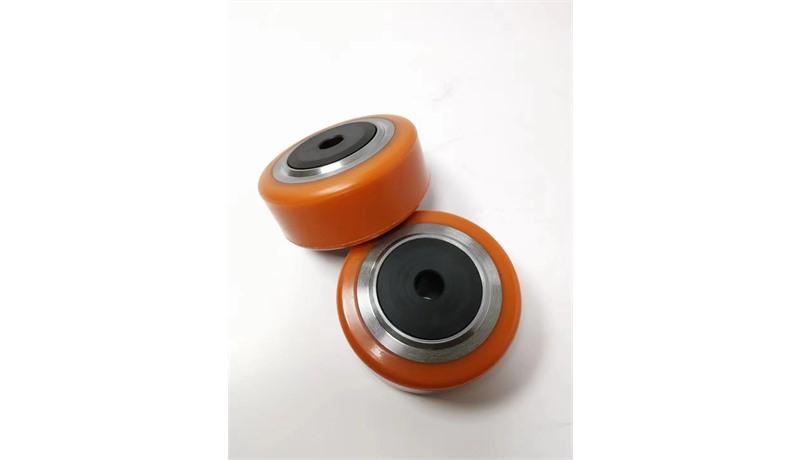
Automated guided vehicles put loads on wheels that no operator ever checks. Wheel load, floor flatness and hub tolerance decide whether an AGV fleet runs for years or eats tyres every quarter.
Why AGV Wheels Fail Differently from Forklift Tyres
A forklift tyre is inspected by a driver every shift. An AGV or AMR tyre is inspected by nobody. That single difference changes the whole specification. On a manned truck, a tyre running hot or wearing unevenly gets noticed and replaced; on an automated vehicle, the same tyre keeps running until the vehicle starts missing docking positions, the drive wheel loses traction on a ramp, or a press-on band spins on its hub.
Automated vehicles also concentrate load very differently. A counterbalance forklift carries most of its mass over the drive axle and the operator counterweights the rear. An AGV carrying a 1,000 kg tote on a low platform can put 60–70% of the total vehicle mass on two or three wheels, and it does so for 20 hours a day with no variation in route. Whatever load a wheel sees, it sees thousands of times per shift — which turns a small specification error into a predictable wear pattern rather than an occasional problem.
The practical consequence: AGV wheel selection is a load-and-tolerance exercise first, and a rubber-compound exercise second. Buyers who start from compound usually come back for a second specification round within a year.
The Four Wheel Types Used on Automated Vehicles
Most AGV and AMR platforms mix wheel types, because drive, steering and load-carrying functions have different requirements. Knowing which wheel you are specifying avoids the common mistake of ordering "AGV tyres" as a single item.
- Press-on rubber band (steel-band tyre) — pressed onto the drive or steer hub, used on electric counterbalance and reach trucks that have been automated. High load per wheel, low speed, replaceable without changing the hub.
- Moulded solid tyre — rubber bonded directly to a rim, used on heavier automated platform trucks and tow tractors. Better heat dissipation than a thin band, longer wear life at higher speeds.
- Polyurethane drive wheel — cast or machined PU on a steel or aluminium hub, standard on light AGV and AMR drive units. High abrasion resistance and precise dimensional control, but sensitive to floor contamination and to heat build-up at continuous high load.
- Castor and idler wheels — usually PU or rubber on a bearing hub. Cheap individually, but the most common source of vibration and floor marking on a fleet, because they are specified last and least carefully.
JABIL Technical Note
A single AGV often uses three different wheel specifications. Ordering all wheels to the same compound is a frequent cause of premature castor failure.
Step 1: Calculate Load Per Wheel, Not Load Per Vehicle
This is the specification step that is most often skipped. A vehicle rated at 1,500 kg does not put 375 kg on each of four wheels. Load distribution depends on where the centre of gravity sits, whether the load is offset, and whether the vehicle accelerates, brakes or turns on a ramp.
A workable method for buyers without a full simulation: take the worst-case static corner load from the vehicle integrator, then apply a dynamic factor. Most automated warehouse vehicles run low speeds (below 2 m/s), so a factor of 1.3–1.5 covers acceleration, braking and floor transitions. For vehicles operating on ramps, in cold stores, or with off-centre loads, 1.6–1.8 is more realistic.
Then compare that number with the tyre datasheet — and make sure the datasheet figure is stated at the vehicle's actual speed and duty cycle. A press-on band rated 2,000 kg at 10 km/h is not rated 2,000 kg at 25 km/h. Speed-graded load tables exist for exactly this reason, and a supplier who cannot produce one for the size you need is a supplier to avoid on automated applications.
JABIL Technical Note
Rule of thumb used by fleet engineers: specify the wheel to at least 1.3× the worst-case static corner load, and never to the average load across four wheels.
Step 2: Match Wheel Diameter to Floor Condition
Wheel diameter sets obstacle clearance and rolling resistance. A larger wheel rolls over expansion joints and floor damage that a small wheel hits head-on. On a 24/7 AGV route, that difference shows up as vibration, load shift, and wear on the vehicle's own structure rather than on the tyre.
Floor quality is measurable, and it should be measured before the wheel is chosen. Warehouse floors are commonly assessed against a straightedge: a floor that deviates by more than about 3 mm under a 1 m straightedge will cause noticeable vibration on small-diameter wheels. Joints, drain covers and dock levellers are the usual offenders, and they are exactly where automated vehicles slow down — concentrating wear at the same spot every cycle.
For routes crossing dock levellers or outdoor aprons, a larger diameter solid tyre with a lug or ribbed tread is usually the better compromise than a small smooth wheel chosen for indoor quietness.
Step 3: Choose Compound by Floor, Not by Price
Three compound decisions cover most automated warehouse applications.
- Standard black rubber — best wear life on clean concrete and asphalt; the default for ambient warehousing and logistics centres.
- Non-marking (white or grey) compound — required where finished floors, food production, pharmaceutical or electronics assembly areas are involved. Non-marking wheels carry essentially the same load rating as black compound; the trade-off is cost and slightly lower abrasion resistance, not capacity.
- Polyurethane — specified for drive wheels where dimensional accuracy and abrasion resistance matter more than shock absorption. PU handles high load at low speed well, but degrades quickly if the floor carries oil, solvent or abrasive grit.
JABIL Technical Note
Oil-resistant and anti-static compounds are available for chemical plants, paint lines and electronics areas. Both are compound changes, not new moulds, so they are usually available at the same MOQ as standard production.
Step 4: Treat the Hub Fit as Part of the Tyre Specification
On automated vehicles, a press-on band that is 0.2 mm loose will spin on its hub under repeated acceleration, and a drive wheel with poor concentricity will produce a vibration that the navigation system interprets as position error. Both failures are invisible at goods-in and appear weeks later as downtime.
When ordering press-on tyres for AGV drive units, specify the hub diameter and the interference fit you expect, and ask for the bore tolerance in writing. For PU drive wheels, specify bore tolerance, keyway or bolt pattern, and radial runout. Vehicles running above roughly 1.5 m/s benefit from dynamically balanced drive wheels; below that, static balance is normally sufficient.
It is also worth agreeing a wear limit at the order stage — the tread depth at which the wheel must be replaced — so that maintenance intervals can be planned instead of discovered.
The Eight-Point Specification Checklist
A specification sheet that answers these eight questions can be quoted accurately by any competent solid tyre manufacturer, without a round of clarification emails.
- Wheel type and mounting method (press-on band, bonded solid, PU on hub, castor)
- Full size marking as moulded on the original wheel, including rim or bore dimension
- Worst-case static load per wheel, and the vehicle's maximum speed
- Duty cycle in hours per day, and whether operation is continuous or intermittent
- Floor type and condition: sealed concrete, epoxy, tiled, outdoor apron, joints and ramps
- Compound requirement: standard black, non-marking, oil-resistant, anti-static
- Hub dimensions and tolerances, plus balancing requirement for drive wheels
- Packaging and delivery schedule — mixed containers are normal for fleet rollouts
Working with JABIL
JABIL Rubber Co., Ltd. manufactures solid tyres, press-on bands and polyurethane wheels in Shandong, China, for forklift, aerial work platform, port and automated material handling applications. Production covers standard black, non-marking, oil-resistant and anti-static compounds, with OEM sidewall branding, custom bore dimensions and mixed-container loading from MOQ 20 pieces.
For automated vehicle projects, send the eight-point specification above — or simply the original wheel dimensions and the vehicle's load and speed data — and the technical team will confirm the closest standard size and the compound that fits the floor condition.
Specifications referenced in this guide
Size and product pages with the published rim, dimensions and load data discussed above.
Have questions about your specific application?
Frequently Asked Questions
Can a standard forklift press-on tyre be used on an automated truck?
In many cases yes, provided the load per wheel and the speed rating are checked against the automated duty cycle. Automation usually raises the duty cycle rather than the load, and continuous operation is where an under-specified band fails first.
Is polyurethane always better than rubber for AGV drive wheels?
No. PU gives better dimensional accuracy and abrasion resistance on clean floors, but rubber absorbs shock and tolerates floor contamination better. The choice follows floor condition and load, not a general preference.
How long should an AGV wheel last?
Life is driven by load, speed, floor abrasiveness and route, not by calendar time. Fleets that record tread depth per 500 operating hours get a reliable replacement forecast within two quarters; fleets that replace on failure usually keep discovering the same problem on the same route.
Do non-marking wheels reduce load capacity?
Not materially. Non-marking compounds are formulated to similar hardness and load ratings as standard black compound; the differences show up in cost and in abrasion resistance on rough floors.
What is the minimum order for a custom AGV wheel?
At JABIL, custom compound and OEM sidewall branding typically start from 20 pieces per size, with mixed sizes combined in one container. Special bore or hub modifications are quoted case by case.