
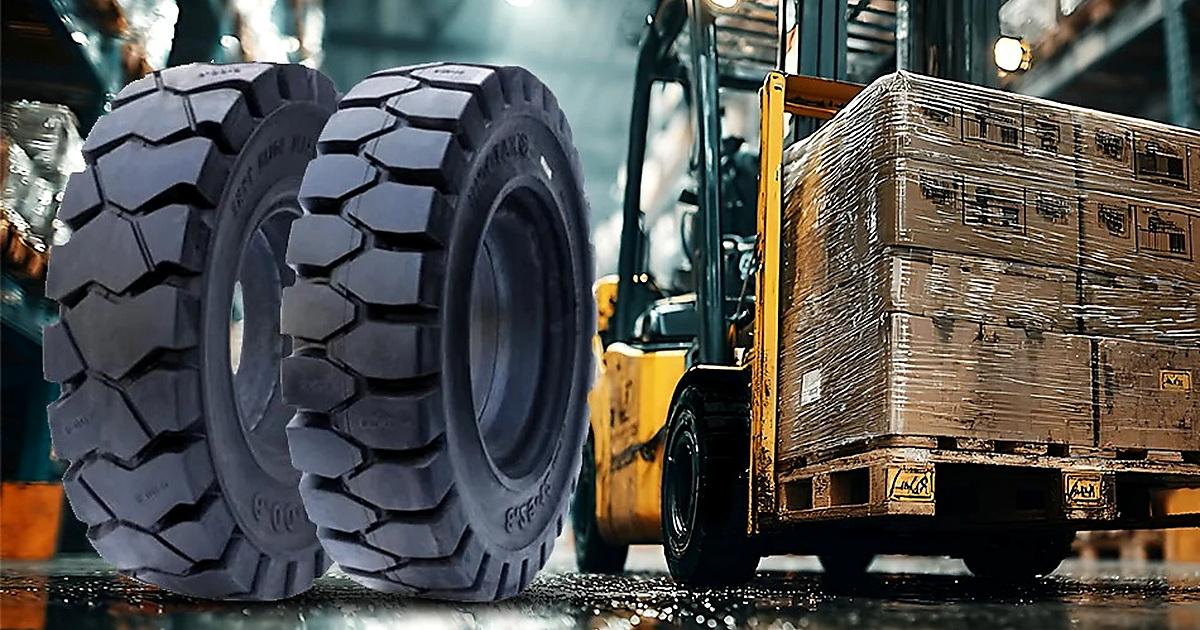
Solid tyres rarely go flat, but they do wear out. The 60B wear line, sidewall cracking, chunking and delamination are the four failures that end a solid tyre’s service life — here is how to spot each one before it stops your truck.
The Short Answer: Replace at the 60B Wear Line
Most industrial solid tyres carry a raised "60B" marker on the shoulder. This is the manufacturer’s minimum remaining rubber depth above the base compound. When the tread wears down to the top of the 60B lettering, the tyre has reached its wear limit and must be replaced — running below it risks base-layer exposure, sudden heat build-up and rim damage.
A practical rule for fleet managers: measure the remaining rubber at the drive axle every 250 operating hours. A typical 18×7-8 forklift solid tyre on a two-shift indoor fleet lasts 12–18 months; outdoor lug-pattern tyres in abrasive yards can wear out in half that time.
7 Warning Signs It Is Time to Replace
Inspect for these seven failure modes during every service interval:
- Wear at or below the 60B line — the only mandatory replacement criterion; the other six are conditional failures.
- Chunking — lugs or tread pieces torn out by dock plates, curbs or debris. Small edge chips are cosmetic; chunks exposing the base compound are not.
- Bonding (delamination) failure — a visible gap or bulge where rubber separates from the steel band or base. Replace immediately; the tyre can part from the rim under load.
- Cracking to the base layer — deep radial cracks from heat ageing or ozone exposure. Surface weathering is acceptable; cracks that reach the base compound are not.
- Flat-spotting and out-of-round wear — caused by aggressive braking or a dragging brake; the truck vibrates at speed and the tyre can no longer be trued.
- Rim slippage or spin damage — the tyre has rotated on the rim, shearing the fitment area. Check torque and rim condition at refitment.
- Heat damage — glazing, blisters or a burnt smell from prolonged high-speed runs; hardness increases and grip drops even if tread depth remains.
Why Solid Tyres Fail Differently from Pneumatics
A pneumatic tyre announces its end of life with a puncture. A solid tyre wears gradually, which is precisely why replacement planning matters: a truck can run for months on a tyre that is quietly transmitting shock to the axle, the operator and the driveline.
Worn solid tyres also change load distribution. As section height reduces, the load carrier flattens against the floor, raising rolling resistance and battery consumption on electric trucks — fleets often see runtime drop before they ever see the wear line.
A 10-Minute Monthly Inspection Routine
Add four checks to your monthly forklift service sheet. First, measure remaining rubber at three points around the circumference of each drive-axle tyre and record the lowest reading. Second, look for chunking and cracks under the shoulder, not just on the tread face. Third, rock the truck side to side and watch the tyres: movement on the rim means the press fit has been lost. Fourth, compare drive and steer axle wear rates — a steer tyre wearing much faster than its twin usually points to alignment or braking issues rather than the tyre itself.
When readings approach the limit, order replacements before the truck is grounded. Lead time on export solid tyres is typically 15–30 days, so a fleet that quotes at the 80% wear mark never waits on rubber. Small trucks are the easiest place to start — the 4.00-8 solid tyre size page lists load ratings and compounds for the most common electric pallet and counterbalance applications.
Buying the Replacement Set
Match three things when you reorder: size and rim width, compound (standard black or non-marking), and speed-rated load capacity at your operating speed. If your original tyres lasted well, reorder the same specification; if they chunked or cracked early, discuss a harder compound or a deeper lug pattern with your supplier before repeating the order.
JABIL publishes full specification and load data for every size we manufacture, and our team reviews failure photos from customer fleets at no charge to recommend the right compound for the application.
Have questions about your specific application?
Frequently Asked Questions
How do I know a forklift solid tyre needs replacing?
Replace when tread wear approaches the wear indicators, when the tyre is cut or chunked deeply, when the rubber has separated from the rim or band, or when the driver reports loss of grip. Any one of those is enough on its own.
Can a solid tyre be worn past its limit safely?
No. A solid tyre worn to the point where the rubber is thin stops cushioning the truck and its load, transfers shock into the axle and bearings, and loses traction. The cheapest tyre to run is one replaced at the right time.
How often should tyres be inspected?
Make a tread-and-sidewall check part of the weekly truck walkaround and have a full wheel inspection at every scheduled service. Most premature failures are visible days or weeks before the driver notices a handling change.
Does replacing tyres in axle pairs matter?
On the drive axle it matters a great deal: a mismatched pair causes uneven wear, drivetrain load and steering pull. Replacing drive tyres as a matched pair is nearly always cheaper over the tyre life than replacing them one at a time.
Should I replace all four tyres together?
Not necessarily. Drive and steer axles wear at different rates, so pairing within an axle is the practical rule. Replace across both axles together only when the load and duty cycle genuinely call for it.