
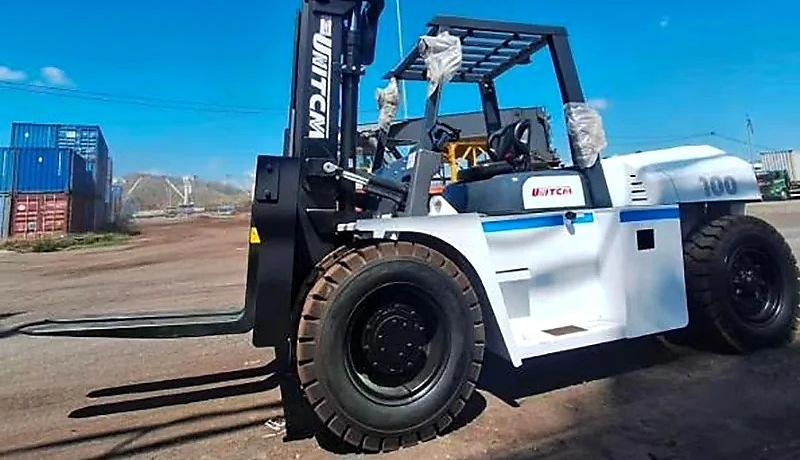
Both solid and pneumatic tyres have their place in forklift applications. This article compares both types across key criteria including maintenance cost, surface suitability, and lifespan.
What Is a Solid Forklift Tyre?
A solid tyre (also called a resilient tyre) is made from a single moulded block of rubber compound with no air cavity. It is fitted onto a multi-piece rim and pressed onto the wheel. Because there is no air, it cannot be punctured — the tyre continues to operate regardless of what it runs over.
Solid tyres are standard equipment on the majority of electric counterbalance forklifts, reach trucks, and most indoor material handling equipment.
What Is a Pneumatic Forklift Tyre?
A pneumatic tyre contains an air-filled inner cavity (or tube, in tube-type variants) that absorbs shock and provides cushioning. They are used on engine-powered forklifts operating outdoors or on rough terrain where the ground surface is irregular.
Pneumatic tyres look similar to large truck or agricultural tyres and require regular pressure monitoring and maintenance.
Key Comparison: Solid vs. Pneumatic
The table below summarises the key differences:
- Puncture resistance: Solid — immune to punctures. Pneumatic — can be punctured, requiring repair or replacement.
- Ride comfort: Solid — stiffer ride. Pneumatic — cushioned ride, absorbs more vibration.
- Surface suitability: Solid — smooth to moderately rough floors. Pneumatic — rough terrain, outdoor surfaces, gravel.
- Maintenance: Solid — virtually zero maintenance. Pneumatic — requires regular pressure checks and occasional repair.
- Load capacity: Solid — rated up to very high loads with correct tyre selection. Pneumatic — similar, varies by size.
- Service life: Solid — typically longer on smooth surfaces. Pneumatic — varies by conditions, vulnerable to cuts and tears.
- Cost over time: Solid — lower TCO indoors. Pneumatic — lower initial cost but higher maintenance overhead.
When to Use Solid Tyres
Solid tyres are the right choice when:
- The forklift operates primarily on smooth concrete, asphalt, or warehouse floors
- Eliminating puncture downtime is a priority
- The facility requires non-marking or clean-floor compliance
- The forklift is an electric model (most electric forklifts are designed for solid tyres)
The classic case is the 2.5–3 tonne counterbalance truck on a 6.00-9 — see the 6.00-9 solid forklift tyre specification as the reference fitment. The bigger the truck, the stronger the case for solids — a 28x9-15 solid tyre on a 5-tonne truck removes a flat that would otherwise stop a whole dock.
When to Use Pneumatic Tyres
Pneumatic tyres are the correct choice when:
- The forklift regularly operates outdoors on rough, unpaved, or heavily contaminated surfaces
- Operator comfort over long shifts on uneven ground is a priority
- The forklift is a diesel or LPG model designed for outdoor use
- Ground clearance and grip on loose surfaces are critical safety factors
If your trucks only occasionally leave smooth ground, the middle path exists: converting to 4.00-8 solid tyres keeps the same rim on lighter equipment.
Have questions about your specific application?
Frequently Asked Questions
What is the difference between solid and pneumatic forklift tyres?
Pneumatic tyres contain air and cushion the load over rough ground; solid tyres are moulded rubber with no air, so they cannot go flat and hold their shape under heavy load. Both are mounted on rims, but they are not interchangeable on the same truck.
Which is better, solid or pneumatic?
Solid for high-load, short-cycle work on prepared surfaces and where downtime is costly; pneumatic for rough, uneven or long-distance running where ride and ground contact matter more. The application decides, not a general preference.
Can I convert a pneumatic truck to solid tyres?
Often yes, but it depends on the rim, the axle load and the machine speed, and it should be confirmed rather than assumed. A conversion that ignores the load rating is a safety problem, not just a fitting problem.
Why do solid tyres feel harsher?
Because there is no air to absorb shock. The rubber compound and the tyre section provide all the cushioning. Where ride comfort matters, a correctly specified solid can be noticeably better than a worn or over-inflated pneumatic, but it will never fully match a pneumatic on rough ground.
Which type costs less to run?
Solid tyres usually cost less per hour in high-downtime-cost operations because they eliminate punctures and last longer in abrasive indoor work. Pneumatics can cost less where replacement is cheap and the surfaces are too rough for solid rubber.