
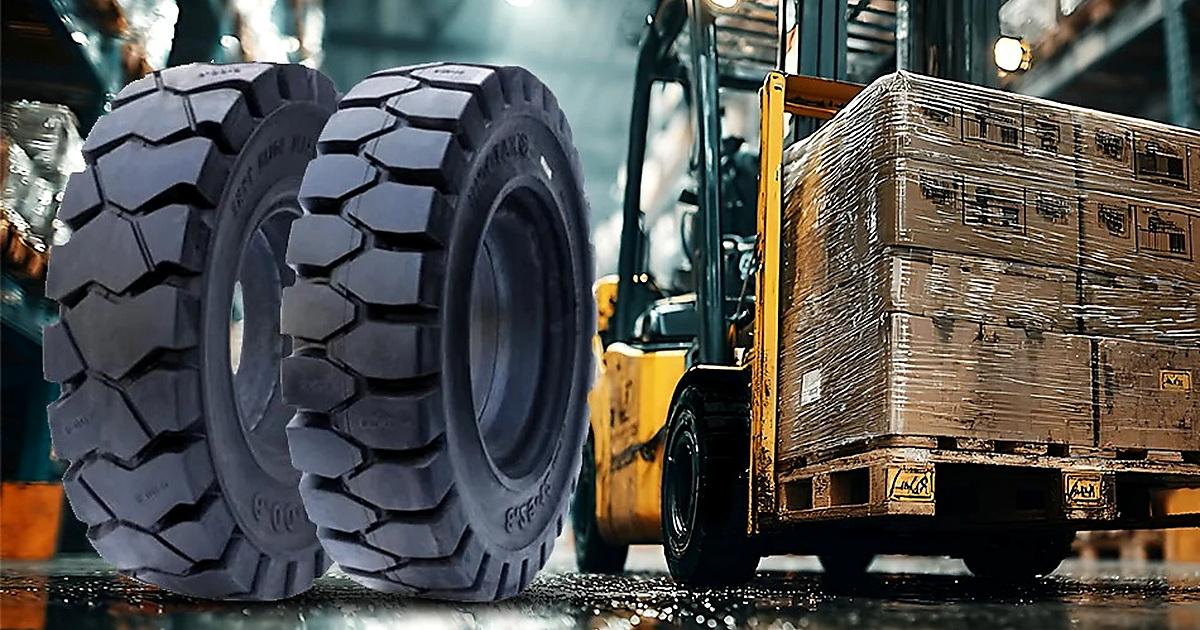
Two solid tyres of the same size can differ in service life by a factor of three. The difference is made before the tyre is ever moulded: compound formulation and curing control. Here is what actually goes into a wear-resistant industrial solid tyre.
The Short Answer: Compound and Cure Decide Everything
For the same size — say an 18×7-8 — one factory’s solid tyre can last three times longer than another’s on the same fleet. Fitment and dimensions are identical; what differs is the rubber compound (natural rubber to SBR ratio, carbon black structure, vulcanising system) and how tightly the curing temperature and pressure were controlled. Buyers who compare only price per tyre are usually comparing different compounds wearing at different rates.
What Goes Into the Compound
An industrial solid tyre compound balances four properties that pull against each other: abrasion resistance, cut resistance, heat build-up and resilience. A high-SBR compound wears slowly on abrasive concrete but runs hotter under continuous load; a natural-rubber-rich compound dissipates heat better and resists tearing, which is why it dominates in ports and scrap yards. Carbon black grade and loading tune hardness (typically 60–75 Shore A for forklift drive tyres) and reinforce the tread against chunking on dock plates.
For non-marking compounds the carbon black is replaced with silica and light fillers — the trade-off is a modest reduction in abrasion resistance, which is the honest cost of a clean floor. Compounds can also be adjusted for heat, oil exposure and anti-static requirements; the 7.00-9 solid tyre page shows how the same size is specified with pattern and load data alongside the standard compound.
Why Curing Control Matters as Much as the Recipe
Mixing distributes the ingredients; curing locks the properties in. Solid tyres are cured in moulds under heat and pressure for a cycle that is set per size and compound — under-cure leaves the base compound soft and prone to heat build-up, over-cure hardens the tread and chips on impact. Because a solid tyre is a thick rubber block, the temperature gradient from tread to base is significant, and multi-stage pressurised curing is used to even it out.
This is where factory quality systems earn their keep: batch records, cure-curve monitoring and finished-tyre hardness checks catch the drift that no visual inspection will. Buyers auditing a supplier should ask for hardness test reports per batch, not just a catalogue sheet — this is standard practice in a factory-direct supply conversation and a good filter for trading companies reselling other people’s production.
What This Means When You Buy
Three practical takeaways: first, match the compound to the duty cycle, not the price list — a yard truck needs cut resistance, a two-shift indoor fleet needs low heat build-up. Second, ask what hardness range the supplier targets for your application; a single "one compound fits all" answer is a red flag. Third, when a heavy size matters to your operation, order the same specification repeatedly and track wear — consistency between batches is the real quality signal.
The same logic applies across product lines: press-on cushion tyres carry the same compound decisions in a band-mounted format — see the 28x12.5x22 heavy press-on tyre for the large end of the range — and the 4-piece industrial forklift rim completes the assembly so the tyre works on the rim it was designed for.
JABIL Technical Note
JABIL compounds and cures in-house at its Dongying facility under ISO 9001:2015 certification, with batch hardness reporting available to importer and OEM customers on request.
Have questions about your specific application?
Frequently Asked Questions
What is a tyre compound?
The compound is the exact recipe of rubber, carbon black, oils, sulphur and additives the tyre is made from. Two tyres in the same size and tread can behave completely differently in the same application if the compound differs.
How does compound affect wear life?
A harder, more cut-resistant compound lasts longer on abrasive or debris-strewn floors; a softer one grips better and cushions more but wears faster. There is no universally best compound — only the best one for your floor, load and duty cycle.
What is a non-marking compound?
A compound formulated with non-staining ingredients so the tyre leaves no black marks on finished floors. It is used in food plants, hospitals, retail and clean production areas, and is normally made to order because the formulation differs from standard black.
Can compound be adjusted for special environments?
Yes. Anti-static, oil-resistant, high-temperature and cold-store formulations can all be produced at the factory. Special compounds are usually a minimum-order and lead-time question rather than a technical barrier.
How do I know which compound I need?
Describe the floor, the load, the speed, the temperature and any contamination, and the compound follows from that. Sending a photo of the worn tyre is often the fastest way to identify what is failing and why.